Introducing Teen V1: Expressive multilingual speech at production scale
A technical account of Teen V1’s LLM backbone, factorized voice conditioning, multilingual scope, serving economics, and evaluation protocol.
Open the voice playground
Voice cloning and expressive control are commonly collapsed into one conditioning signal. This couples speaker similarity to the prosody of the reference recording: changing the emotional delivery can disturb identity, while strengthening the identity match can pull the output toward one static speaking style. Teen V1 factorizes these controls into speaker-identity and utterance-performance paths, applies both to a pretrained open-source 3-billion-parameter language-model backbone, and serves the resulting speech through batch and streaming inference at approximately $5 per million input characters.
The central hypothesis is that speaker identity is primarily a global property, while rhythm, emphasis, intonation, energy, and affect are utterance-level properties. Modelling them separately should provide a larger and more controllable space of performances than a single cloned-voice representation.
Problem formulation
Let be the target text, a reference recording that identifies the target speaker, a performance-prompt recording, and the exact transcript of . The conceptual conditioning variables are:
- , an identity representation derived from the reference recording.
- , a performance representation derived from aligned prompt audio and text.
The sequence model generates an internal speech representation . A fine-tuned 48 kHz Qwen-Audio-VAE serves as the acoustic decoder, mapping that representation to waveform . The factorization is independent of whether is implemented as a discrete codec sequence or a continuous acoustic latent.
The inference surface exposes four conditioning regimes:
| Regime | Identity signal | Performance signal | Intended constraint |
|---|---|---|---|
reference | None | Preserve speaker identity | |
continuation | None | , | Continue the prompt’s delivery |
ultimate | , | Preserve identity while transferring delivery | |
auto | Inferred from supplied fields | Inferred from supplied fields | Select the valid conditioning path |
Reference inputs may be WAV, MP3, FLAC, or OGG. Prompt conditioning requires prompt audio, its format, and an exact transcript so that linguistic content can be separated from delivery information. Conditioning is performed per request rather than through a mandatory offline clone-training and saved-slot workflow.
Factorizing identity from performance
A single speaker representation is sufficient when the only target is recognisable timbre. It is less suitable when the same speaker must move between restrained narration, urgent alerts, warm assistance, energetic dialogue, or subtle conversational turns without creating a new clone.
The distinction can be expressed as two timescales:
| Property class | Typical scope | Examples |
|---|---|---|
| Speaker identity | Stable across many utterances | Timbre, habitual pitch range, accent, vocal-tract characteristics |
| Performance state | Changes by utterance or phrase | Pace, rhythm, stress placement, pause structure, intonation, energy, restraint, emotional intensity |
An identity-only clone tends to entangle both classes because its reference recording contains both. If the reference is excited, the clone can inherit excited pacing even when the next sentence should be calm. If the system suppresses that performance leakage, it may also discard useful speaker detail.
Factorized conditioning introduces a second observation. The identity reference specifies who should speak, while the performance prompt specifies how the current utterance should unfold. In ultimate mode, a calm performance prompt can be combined with one identity reference and a high-energy prompt with the same identity reference without retraining or allocating another stored voice.
Performance audio also carries information that is difficult to express through categorical controls such as happy, sad, or angry. Emotion is not a scalar. Two recordings with the same broad label can differ in onset energy, phrase-final contour, local emphasis, pause duration, speech rate, and degree of restraint. Prompt conditioning provides a continuous example of those interacting variables rather than forcing them through a small preset vocabulary.
The resulting control space is compositional. Multiple permitted identities can share one performance reference, and one permitted identity can be rendered under multiple performance references. The number of usable voice-performance combinations is therefore not bounded by a saved-clone catalogue, although synthesis remains metered and subject to ordinary request and concurrency limits.
LLM-centred architecture
Teen V1 uses a pretrained open-source 3-billion-parameter large language model as its central sequence-modelling backbone. The backbone is responsible for modelling the dependency between linguistic context, conditioning context, and the evolving speech representation. This places language structure inside the generative core instead of treating it as a shallow front-end feature.
The synthesis stack contains five logical stages:
| Stage | Input | Function | Output |
|---|---|---|---|
| Text front end | Target text | Produce the representation consumed by the backbone | Linguistic sequence |
| Identity conditioning | Reference audio | Extract speaker-stable information | |
| Performance conditioning | Prompt audio and transcript | Extract delivery information while accounting for spoken content | |
| LLM backbone | Linguistic sequence, , | Model the conditioned speech sequence | Internal speech representation |
| Acoustic decoder | Reconstruct the generated speech representation with a fine-tuned Qwen-Audio-VAE | 48 kHz waveform |

Pretraining supplies the backbone with a language-aware initialization before speech-specific conditioning is applied. Language modelling alone is insufficient for synthesis: the conditioning and acoustic stages determine whether linguistic representations become a stable speaker, an appropriate performance, and a clean waveform. Identity and performance influence the generated sequence directly rather than being applied only as a final waveform transformation. On the audio side, the fine-tuned Qwen-Audio-VAE converts the generated representation into 48 kHz waveform audio.
Compute-efficient training through language reuse
Training a multilingual speech model from random initialization would require the same compute budget to solve two large problems at once: learning how written language is structured and learning how that structure maps to speech. Teen V1 avoids the first problem by initializing its generative core from an existing 3B open-source LLM whose pretraining had already established representations for the supported languages.
This is transfer learning at the sequence-model level. The inherited model begins with useful representations of tokens, syntax, semantic relationships, and long-range textual context. Teen V1 training does not need to rediscover those properties from speech pairs alone. It specializes an already language-competent network for speech generation.
| Training responsibility | Starting point | Teen V1 compute allocation |
|---|---|---|
| Multilingual token and context representation | Reused from the pretrained 3B LLM | Adapt rather than learn from random initialization |
| Text-to-speech representation mapping | Not supplied by the base language model | Learn during speech specialization |
| Speaker-identity conditioning | Teen V1-specific | Learn reference-to-identity control |
| Performance conditioning | Teen V1-specific | Learn prompt-to-prosody and affect control |
| Acoustic reconstruction | Reused from Qwen-Audio-VAE | Fine-tune the decoder for Teen V1 and 48 kHz waveform output |
| Streaming behaviour | Serving-specific | Optimize chunking, ordering, and inference latency |
The same reuse principle applies to the audio path. Instead of training a waveform autoencoder from scratch, Teen V1 fine-tunes Qwen-Audio-VAE for 48 kHz reconstruction. The training budget is therefore concentrated on speech generation, conditioning, and alignment between pretrained language and audio components rather than recreating either prior from zero.
The practical consequence is that the available compute can be concentrated on making the pretrained language model speak: aligning its linguistic state with the internal speech representation, teaching the model how identity and performance conditions alter that sequence, and reconstructing intelligible audio. Language competence is reused; speech competence is the adaptation target.
This does not imply that language representations remain completely unchanged during training. Depending on the adaptation strategy, some or all backbone parameters may still be updated. The efficiency comes from the initialization: optimization starts from a multilingual language solution instead of paying to construct one from scratch.
Training efficiency is characterized by the fraction of trainable backbone parameters, frozen-layer schedule, adapter configuration, audio hours, accelerator-hours, numerical precision, batch construction, and convergence criterion. These variables separate speech-specialization cost from the language pretraining already embodied in the base model.
Streaming and inference
Teen V1 provides a latency-oriented fast profile and an expressive profile through the same model interface. The profiles expose an application-level quality-latency tradeoff without changing the conditioning formulation.
Complete text can be synthesized through raw HTTP audio streaming or ordered server-sent audio.delta events. Incremental text can be supplied over a WebSocket session, allowing synthesis to begin while an upstream language model is still producing a response. PCM and MP3 support streaming paths; WAV is emitted as a complete response. The native acoustic decoder is fine-tuned for 48 kHz output, while the serving interface exposes output sample rates from 8 kHz to 48 kHz.
Streaming performance has two independent axes. Time to first audio measures how quickly playback can begin. Real-time factor measures how quickly the complete waveform is synthesized relative to its duration. A system may achieve low onset latency while accumulating a generation backlog, so neither metric substitutes for the other.
The serving layer must also preserve ordering and avoid replay ambiguity. A retry after partial audio delivery can duplicate spoken content. Benchmarking must therefore record failed streams, truncated outputs, and retry behaviour alongside latency percentiles.
Multilingual scope
The supported set contains 23 languages: Arabic, Chinese, Dutch, English, French, German, Greek, Gujarati, Hindi, Italian, Japanese, Korean, Marathi, Norwegian, Polish, Portuguese, Punjabi, Rajasthani, Russian, Spanish, Thai, Turkish, and Urdu.
This coverage spans multiple scripts, word-segmentation conventions, phonological systems, and text-normalization rules. A pooled intelligibility score is insufficient. WER and CER are reported per language and as macro averages so that high-volume languages cannot hide regressions in lower-resource languages. CER is particularly important where tokenization into whitespace-delimited words is unstable or language-dependent.
The multilingual test set includes native-script text, names, numbers, abbreviations, punctuation, mixed-language spans, and loanwords. Reference and prompt recordings are balanced across language, speaker, recording condition, and duration. Cross-lingual identity preservation and cross-lingual performance transfer are reported separately from same-language conditioning.
Serving economics
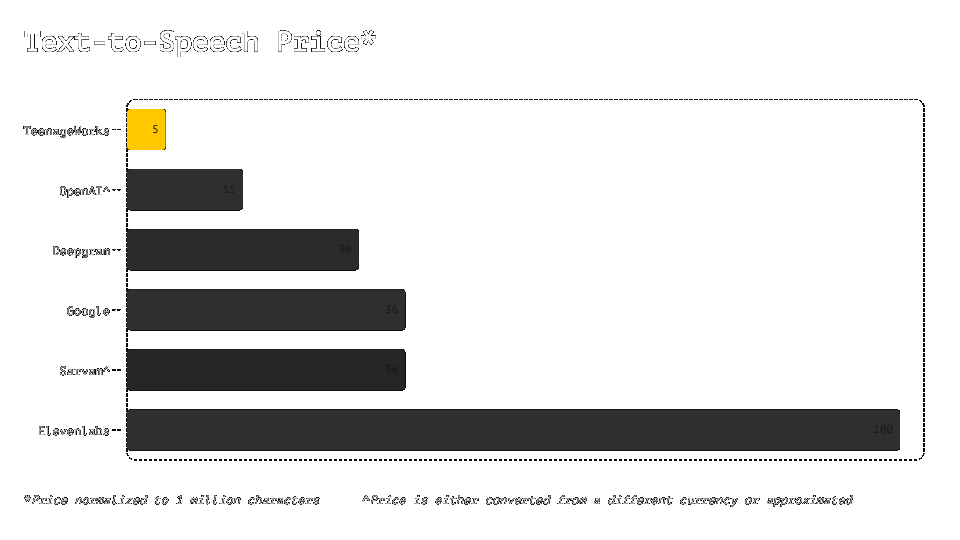
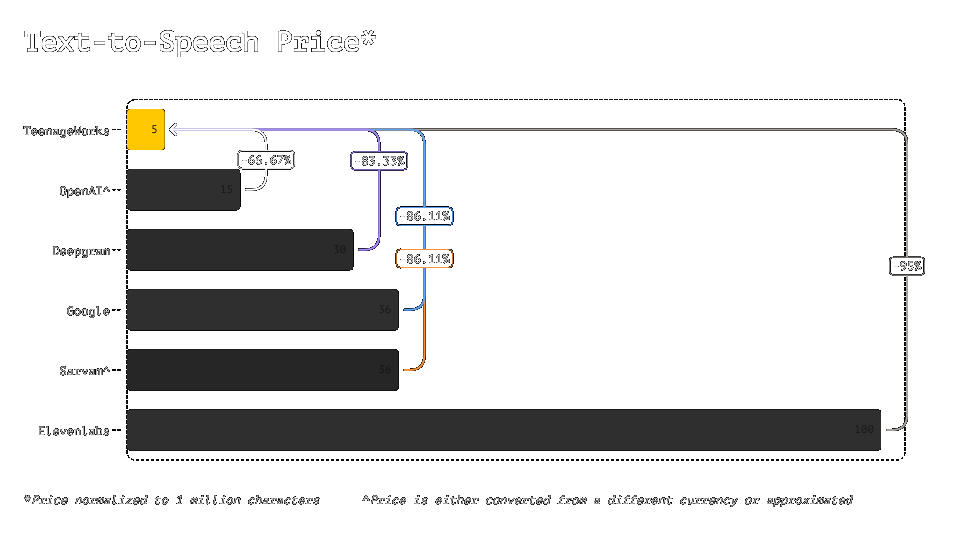
Teen V1 is priced at approximately $5 per million characters, with reference, continuation, and combined voice modelling available in the same synthesis path. Voice conditioning does not require a separate clone-training job or a paid catalogue of saved voice slots.

Across the selected current-generation expressive TTS systems below, Teen V1 reduces normalized list-price synthesis cost by approximately 66% to 95%.
Evaluation protocol
The evaluation stratifies requests by language, text length, conditioning regime, output format, and streaming transport. Every competitor is identified by exact model revision and run with the nearest available quality setting. Client region, server region, network path, concurrency, warm-up policy, retry policy, and sample rate are fixed or reported.
| Metric | Definition | Required reporting |
|---|---|---|
| TTFA | Elapsed time from request submission to the first client-decodable audio | p50 and p95 milliseconds by transport and text-length bucket |
| RTF | Complete generation wall time divided by generated audio duration | Mean, p50, and p95; values below 1.0 are faster than real time |
| WER | Word-level edit distance between normalized source text and fixed-ASR transcription | Per language, macro average, and confidence interval |
| CER | Character-level edit distance from the same transcription pipeline | Per language, macro average, and confidence interval |
TTFA stops at the first client-decodable audio rather than the first response header or server-side token. RTF includes the full synthesis path measured at the client. WER and CER use one ASR model and one normalization pipeline across all systems. Punctuation removal, case folding, number expansion, Unicode normalization, and script-specific segmentation are fixed before results are computed.
WER and CER test intelligibility and textual fidelity, not perceptual naturalness. The complete evaluation adds blinded pairwise preference, speaker-similarity, and prompt-performance transfer tests. Conditioning results are separated into reference, continuation, and ultimate modes to measure interference between identity and performance controls.
Benchmark results
| Metric | Teen V1 fast | Teen V1 expressive | Comparator A | Comparator B | Comparator C |
|---|---|---|---|---|---|
| TTFA p50 | — | — | — | — | — |
| TTFA p95 | — | — | — | — | — |
| RTF mean | — | — | — | — | — |
| RTF p95 | — | — | — | — | — |
| WER macro average | — | — | — | — | — |
| CER macro average | — | — | — | — | — |